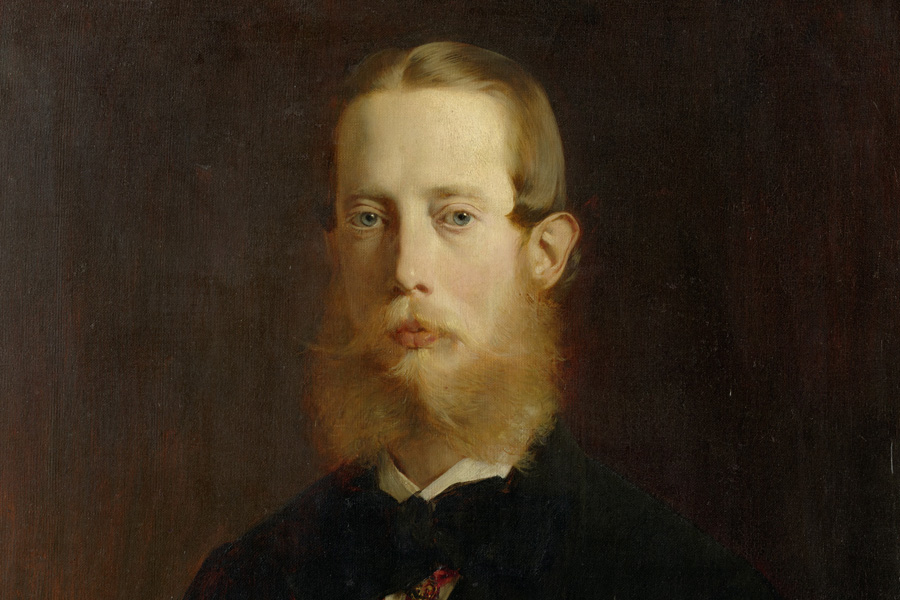
A portrait in velvet and shadow
I always liked characters on the brink of their family story. These include Archduke Ludwig Viktor of Austria. Born 15 May 1842 in the Hofburg Palace, his 76 years felt like two. An archduke who liked collecting more than reigning, a general by position but a patron by nature, his life was a museum of taste and scandal. I imagine him in rooms with china and gilt mirrors, moving slowly around Vienna and Salzburg, creating faint ripples.
He followed the Habsburg princes’ rank pattern. He became General of the Infantry but never entered politics. Instead, he erected a Schwarzenbergplatz house, elegant Salzburg apartments, and a collection that would fill auction catalogues for months following his death. He preferred art, costume, and conversation above crowns and proclamations. The early 1900s event at a public bathhouse changed his public life and transported him from Vienna to Schloss Klessheim, where he spent his last years in peace.
Family and relationships
Archduke Franz Karl of Austria
Archduke Franz Karl was Ludwig Viktor’s father. Born in 1802, Franz Karl was a steady figure in the dynasty, a man who provided lineage more than political drama. He watched his sons take the stage: one became emperor, another became an ill-fated Mexican ruler, and Ludwig Viktor chose a different scene entirely. I see Franz Karl as the sturdy trunk from which the family’s many branches grew.
Princess Sophie of Bavaria
Princess Sophie of Bavaria, born 1805, was the great organizer of the family. She shaped marriages and destinies with the precision of a composer arranging notes. Sophie was the force that pushed dynastic ambition; she was also the mother who attempted to arrange Ludwig Viktor’s marriage, only to find that he refused the role she planned.
Franz Joseph I of Austria
Franz Joseph I, Ludwig Viktor’s elder brother and emperor from 1848 to 1916, was the family’s public face. The relationship between Ludwig Viktor and Franz Joseph was complex. I imagine the emperor as a mountain of protocol and duty and Ludwig Viktor as a wandering stream that could not be forced into one channel. When scandal struck, Franz Joseph’s decisions effectively closed doors in Vienna for his younger brother.
Maximilian I of Mexico
Maximilian I, another elder brother, carried a dramatic fate. He went to Mexico, accepted an imperial crown in 1864, and met execution in 1867. His life was a cautionary tale of imperial overreach. Maximilian’s attempts at dynastic alliance sometimes touched Ludwig Viktor, including approaches about marriage that Ludwig Viktor declined.
Archduke Karl Ludwig of Austria
Archduke Karl Ludwig, born 1833, was a brother whose descendants carried forward the Habsburg line. I think of him as the branch that bore continuity: his line led to later claimants and to the tangled succession dynamics that shaped late Habsburg history. Ludwig Viktor remained childless and so this brother’s line became crucial for dynastic continuity.
Archduchess Maria Anna of Austria
Archduchess Maria Anna was Ludwig Viktor’s sister who died young. Born in 1835 and passing in childhood, she is a small, quiet presence in the family tree. I often pause at such entries and wonder about the private grief that ordinary dates can hide.
Francis II, Holy Roman Emperor
Francis II was the grandfather, an imperial figure shrouded in larger European transformations. As the last Holy Roman Emperor, his life overlapped the twilight of one order and the dawn of modern dynasties. For Ludwig Viktor, Francis II was lineage and legacy.
Leopold II, Holy Roman Emperor
Leopold II appears in the genealogy as an earlier ancestor, a reminder that this family’s roots run centuries deep. Those roots carried expectations, titles, and the weight of history, all of which framed Ludwig Viktor’s choices.
Heinrich von Ferstel
Heinrich von Ferstel was the architect who designed Ludwig Viktor’s Ringstrasse palace. The north facade of that building still holds the memory of salon evenings and glittering collections. I like to imagine Ferstel consulting with the archduke, translating taste into stone and space.
Duchess Sophie Charlotte in Bavaria
Duchess Sophie Charlotte was among the prospective matches suggested by family planners. She represents the marriage market of 19th century Europe, where alliances were negotiated across drawing rooms. Ludwig Viktor declined such arrangements, choosing personal freedom over dynastic bargaining.
Isabel, Princess Imperial of Brazil
Isabel of Brazil was another figure floated as a marriage prospect. Offers like that show how global Habsburg strategy could be: across oceans and courts, ties were sought. Ludwig Viktor’s refusal of these prospects reveals his different priorities.
Career highlights and material life
Thinking in numbers helps me trace a life built on items and ranks. Ludwig Viktor was born 1842, died 1919. General of the Infantry was his military rank. He ordered an 1860s city palace. After his death, his collection was auctioned over many months in 1921 and 1922. Paintings, silver, pottery, jewelry, miniatures, and literature were sold like a life edited.
No laws or edicts came from him. He made chambers. He collected treasures, threw parties, and patronized. Schloss Klessheim, where he lived his latter decades, framed his peaceful years. A bathhouse incident in the early 1900s changed how and where people lived. One action can change a life; one headline can close a salon city.
Timeline table
| Date | Event |
|---|---|
| 15 May 1842 | Born in Vienna |
| c. 1863-1866 | Palais on Schwarzenbergplatz completed |
| 1864-1867 | Brother Maximilian in Mexico, executed 1867 |
| Early 1900s | Public bathhouse scandal and withdrawal from Vienna |
| 18 January 1919 | Died at Schloss Klessheim |
| Apr 1921 – Feb 1922 | Major auctions dispersed his collection |
FAQ
Who was Archduke Ludwig Viktor Of Austria?
I see him as the artful uncle of an imperial family. Born into power on 15 May 1842, he chose collecting and patronage over politics. His life reads like a ledger of objects and residences rather than a chronicle of statecraft.
What was his relationship with his siblings?
He was the youngest among brothers who took starkly different paths: an emperor, a Mexican monarch, a line of succession through Karl Ludwig, and others who defined European politics. He remained outside their political fortunes and often at odds with the expectations set for him.
What caused his exile from Vienna?
A public incident at a central bathhouse in the early 1900s triggered scandal. The result was his effective removal from Vienna’s public life and his retreat to the Salzburg region and Schloss Klessheim.
What happened to his collection?
After his death in 1919, the collection was sold in extensive auctions during 1921 and 1922. The dispersal took months and scattered objects across many buyers, marking the final act in a lifetime of accumulation.
How Efficient Site Preparation Sets Projects Up For Success
The Best Services To Consider For A Stress Free Home Renovation
Steps You Can Take To Improve Your Smile
Services Every Homeowner Should Prioritize During A Renovation
Modernizing Television Networks From Hdmi And Qam Sources To Iptv Multicast And Ip Based Catv